
Wassmuth Powerful Practices
Wassmuth Powerful Practices
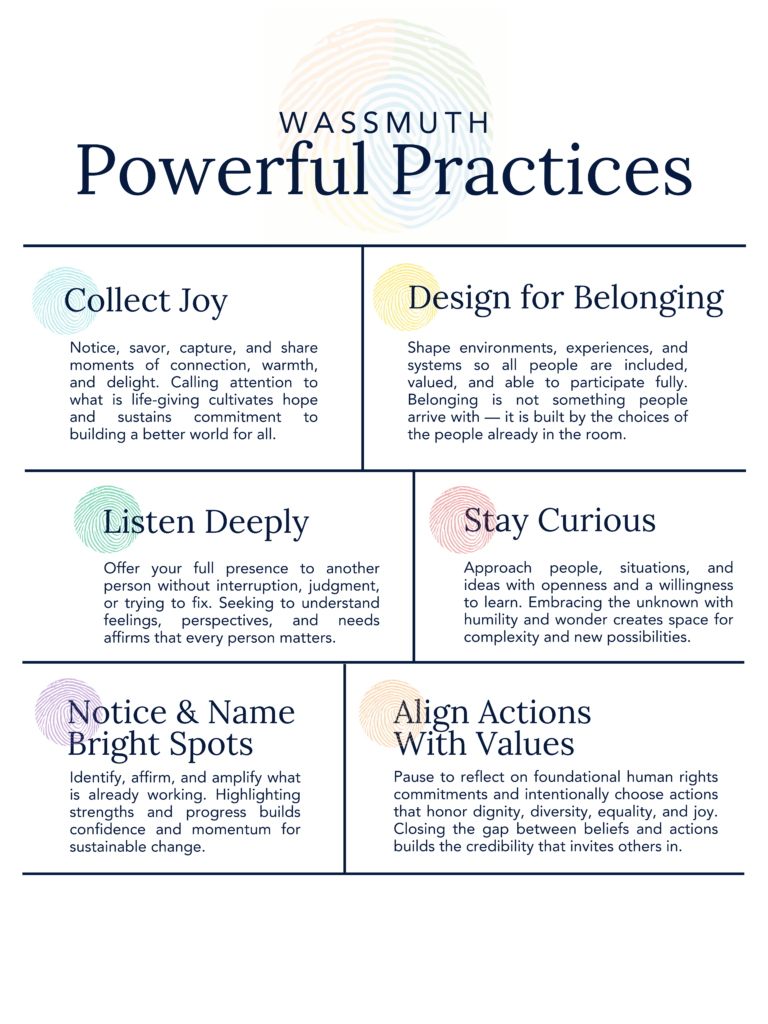
The Wassmuth Powerful Practices is a framework of six interconnected behaviors that helps individuals and communities honor human rights through everyday actions. It turns shared values into practical, repeatable ways of treating one another with care and fairness. Together, the six practices form an integrated system, each supporting the others so that people can practice human rights, not just believe in them.
Collect Joy: Notice, savor, capture, and share moments of connection, warmth, and delight as expressions of human dignity. Paying attention to what is life-giving cultivates hope and sustains commitment to building a better world for all.
Design for Belonging: Shape environments, experiences, and systems so all people are included, valued, and able to participate fully. Belonging is not something people arrive with — it is built by the choices of the people already in the room.
Listen Deeply: Offer your full presence to another person without interruption, judgment, or trying to fix. Seeking to understand feelings, perspectives, and needs affirms that every person matters.
Stay Curious: Approach people, situations, and ideas with openness and a willingness to learn. Embracing the unknown with humility and wonder creates space for complexity and new possibilities.
Notice and Name Bright Spots: Identify, affirm, and amplify what is already working. Highlighting strengths and progress builds confidence and momentum for sustainable change.
Align Actions With Values: Pause to reflect on foundational human rights commitments and intentionally choose actions that honor dignity, diversity, equality, and joy. Closing the gap between beliefs and actions builds the credibility that invites others in.
Human rights are upheld in the ordinary moments — when someone savors something good, widens the circle instead of guarding it, listens to understand instead of to answer, asks a real question, names what is working instead of only what is broken, and does the harder thing because it matches what they believe. These six practices make those choices visible, teachable, and repeatable. They don’t replace law, policy, or collective action, but they build the culture that makes this work possible and sustain the people who do it. And enough of those choices, made by enough people over time, will create just and joyful communities where human rights are a lived reality for all.
Explore the Practices
Cultures of dignity are sustained by how we show up for one another every day. The Wassmuth Powerful Practices name six practices anyone can use in a classroom, a workplace, a congregation, or at the kitchen table. Select a practice to find an overview, readings, and other resources for putting it into action.
Design for Belonging
Notice & Name Bright Spots
Align Actions With Values
“Together, these practices form a shared language and an actionable approach to living out our mission. They are not simply strategies or checklists. They are habits of heart and mind that help us build relationships, navigate complexity, and co-create communities grounded in human dignity.”
-Jess Westhoff, Education Director, Wassmuth Center for Human Rights