
Wassmuth Center Field Trips
Learn at the Center
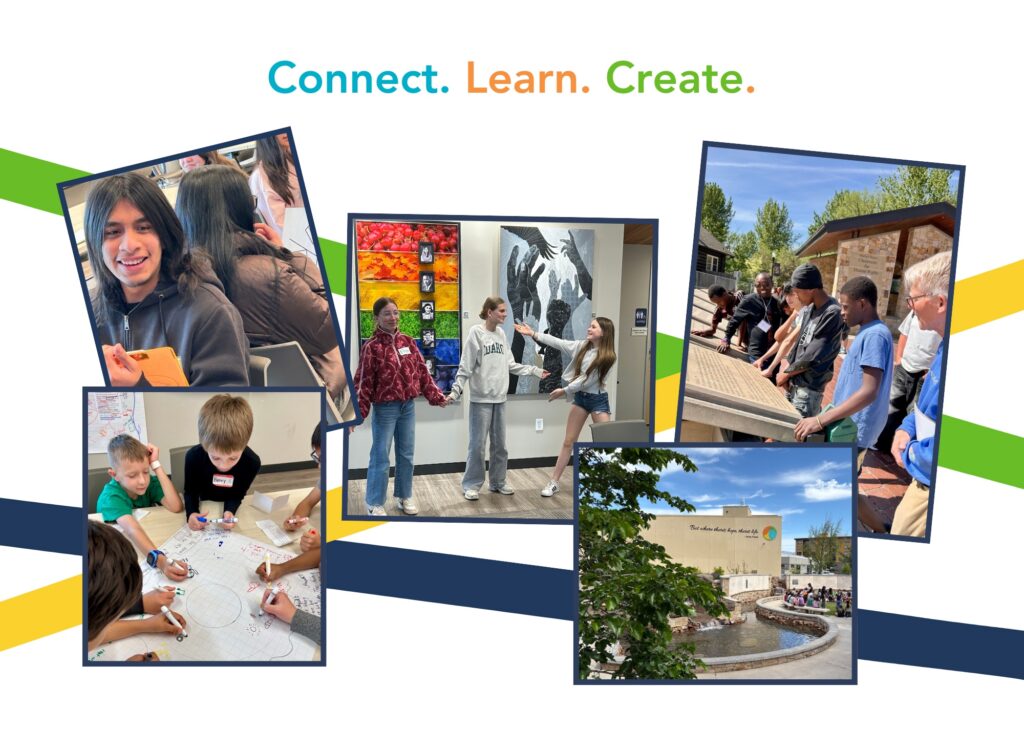
Field trips to the Wassmuth Center bring together history, art, and the enduring questions our communities face. Groups from preschool through college and beyond move between the Memorial and the classroom with our experienced educators. Every visit is designed to meet your students where they are and support your curriculum.
Your students will stand in the only memorial of its kind in the United States — right here in Boise, Idaho. The Idaho Anne Frank Human Rights memorial is an outdoor classroom of stone, water, and words, where a diary written in hiding sits beside the promises the world made afterward. Adjacent is the Philip E. Batt Education Building, where students trade the quiet of the Memorial for the work of making sense of it — hands-on activities, small group discussions, and facilitated exploration.
Younger students learn about rights and responsibilities through the stories of children their own age. Older students take up how democracies erode, the ways communities widen the circle of belonging, and what civic courage costs and what it protects. Across every grade, our field trips build critical thinking, empathy, and a vision for just and joyful communities. Students leave with questions they’ll still be talking about on the bus ride back to school.
Our field trip experiences connect directly with the units you are already teaching: Idaho history, the civil rights movement, the Holocaust, and much more. All offerings align with the Idaho state standards in social studies and English Language Arts.
Every field trip includes pre-visit materials to prepare students and post-visit activities to extend the learning once you’re back in the classroom. The visit isn’t time away from your curriculum. It’s a morning or afternoon inside it.
Beyond the classroom
We create rich learning experiences for more than school classes! Scout troops, youth groups, faith communities, service clubs, workplace teams, book clubs, and retirement communities are all welcome here.
We look forward to welcoming you to the Wassmuth Center for Human Rights!
Field Trip Scheduling
Step 1: Review the field trip options below and select the one the best aligns with what you are teaching.
Step 2: Click the ‘Schedule a Field Trip’ button below to visit our bookings page and select a date and time that works for your group. We offer 2.5 hour-long field trips on Wednesdays, Thursdays, and Fridays from 9:30 AM – 12:00 PM as well as on Wednesdays and Thursday from 12:30 – 3:00 PM. Spots book up quickly, so we encourage you to schedule yours as early as possible.
Step 3: You will receive an email confirming the logistical details of your visit.
Step 4: The Wassmuth Center educator who will be designing and facilitating your group’s visit will connect with you. Two weeks before your visit, they will send you a packet of information about what to expect at the Wassmuth Center as well as several activities you can do with your students before you visit.
Step 5: Field trip to the Wassmuth Center!
Step 6: Your Wassmuth Center educator will send you a follow-up email with materials to support continued learning back in your classroom.
Step 7: Stay connected with the Wassmuth Center and learn about additional resources and opportunities for you and your students!
Questions? Reach out to Jess Westhoff, our education director, at Jess@wassmuthcenter.org.
Field Trip Offerings
Each field trip offers a developmentally appropriate path for students to explore human rights and their role in building just and joyful communities. Use the drop-down menus below to learn more about the field trip options.
JOY (Preschool, Ages 3 - 5)
JOY (Preschool, Ages 3 – 5): Joy is contagious, and young children already know it. Art-making, movement, and storytelling invite our youngest learners to notice how sharing joy ripples out through a classroom, a family, a neighborhood. Preschoolers practice collecting joy — in laughter, in creativity, in small acts of kindness — and discover that everyone belongs here.
FEELINGS (Kindergarten)
FEELINGS (Kindergarten): Kindergarten is often where children first practice being part of a group. Students name what they’re feeling, learn what to do with big emotions, and discover how rules and boundaries help everyone feel safe. Game, stories, and movement build the skills of kindness — toward others and toward themselves.
INCLUSION (1st Grade)
INCLUSION (1st Grade): What makes you you, and what do we share in common? First graders compare what’s unique about each of them while noticing the threads that connect the group. Through discussion and engaging activities, students practice the small moves that make a room feel welcoming: inviting someone in, making space, noticing who’s been left out. They leave with words and skills for building a classroom where everyone is counted in.
COMMUNITY (2nd Grade)
COMMUNITY (2nd Grade): A young boy created community through acts of kindness, and his small gestures had lasting impact. Hands-on activities and art exploration bring his story to life. Students then reflect on the many communities they are part of — schools, neighborhoods, teams — and name where their own small gestures could create meaningful change.
COMPASSION (3rd Grade)
COMPASSION (3rd Grade): Compassion starts with a question: what is it like to be you? Third graders practice listening deeply and staying curious — the habits that turn noticing into caring. Through fun and engaging activities, they’ll discover ways to foster compassion for themselves, others, and their wider communities.
UNITY (4th Grade)
UNITY (4th Grade): Polly Bemis crossed an ocean, survived being sold into servitude, and built a life on the Salmon River that made her an Idaho icon. Her story anchors our central question: what holds people together across real difference? Working shoulder to shoulder on collaborative challenges, students imagine a more just and joyful world for all.
DIGNITY (5th Grade)
DIGNITY (5th Grade): What is human dignity? Students examine how Idaho leaders including Governor Philip E. Batt and Maria Luisa Gayton fought for the dignity of migrant farmworkers. Primary-source inquiry, team-building, and art connect that history to the choices students make in their own lives. Students return to the classroom with social studies content and a shared language for seeing and valuing one another.
COURAGE (6th Grade)
COURAGE (6th Grade): Through the inspiring example of Bill Wassmuth, students trace how one person’s commitment to showing up, speaking out, and working together with his community created positive change. Hands-on activities and dynamic discussions support students in understanding how teamwork, empathy, and informed action can create a just and joyful community.
HOPE (7th Grade)
HOPE (7th Grade): What keeps people going when the outcome isn’t guaranteed? That’s hope — not optimism, not wishful thinking. Students examine how Idaho’s Indigenous Peoples have sustained hope across generations of dispossession and change. Art and discussion give students practice turning “this is hard” into “here’s what I can do.”
BELONGING (8th Grade)
BELONGING (8th Grade): Belonging makes justice visible; you can see it in who gets counted in, and who is excluded. At Minidoka, here in Idaho, Japanese Americans were told by their own country that they did not belong. Students examine what that exclusion cost and what it took to rebuild. Then they put creative and critical thinking to work designing for belonging in their own schools and neighborhoods.
INTERRUPTING THE SPIRAL OF INJUSTICE (9-12th Grades)
INTERRUPTING THE SPIRAL OF INJUSTICE (9th – 12th Grades): Injustice follows patterns, and patterns can be interrupted. Students learn the Spiral of Injustice as a tool for reading historical and contemporary injustice in their own community, then apply the Wassmuth Powerful Practices to find the points where interruption and repair are possible.
JUSTICE (9-12th Grades)
JUSTICE (9th – 12th Grades): Students are supported to think critically about justice through the lens of the Supreme Court decision in Reed v. Reed, which originated in Idaho. Students test what fairness, equality, and rights mean in practice, and explore how to advance justice in our communities.
EMPATHY (9-12th Grades)
EMPATHY (9th – 12th Grades): Empathy is a skill, and it can be learned and practiced. Students work with historical examples and structured reflection to trace how care and connection hold communities together. Through historical examples, reflection, and engaging activities, students explore how actions — both big and small — can advance human rights.
DESIGN FOR BELONGING: HUMAN RIGHTS THROUGH THE ARTS (Kindergarten - 12th Grades)
DESIGN FOR BELONGING: HUMAN RIGHTS THROUGH THE ARTS (Kindergarten – 12th Grades): Empower your students through the arts! This unique fall field trip invites Idaho students to explore human rights through writing and visual art. Lessons are centered on the theme of our 2027 Wassmuth Arts Awards: the Wassmuth Powerful Practice of Design for Belonging. Students will explore examples of writing and art, think critically about the impact of belonging, and draft artworks that imagine a more just and joyful world for everyone. Teachers will receive pre-visit and post-visit resources, aligned with their grade-level, to deepen students’ understanding of human rights issues. In order to allow time for students to revise their artworks for submission, this field trip is only offered through January.
Holocaust History Field Trips
These field trips engage students in the history and implications of the Holocaust through the Dimensions in Testimony Exhibit, where students hold real-time conversations with pre-recorded, high-definition interviews with Holocaust survivors and witnesses. Students ask their own questions and hear each survivor answer in his or her own words. This immersive experience creates a deeply personal connection to the lived experiences of injustice and resilience.
These field trips are limited to groups of 30 students or fewer. If your group is larger than that, please book one of the field trips above instead.
DEEPENING UNDERSTANDING THROUGH HOLOCAUST TESTIMONIES (8-12th Grades)
DEEPENING UNDERSTANDING THROUGH HOLOCAUST TESTIMONIES (8th – 12th Grades): Designed for students with some prior knowledge of the Holocaust, this field trip deepens historical understanding while strengthening critical thinking skills. After a brief overview of key historical context, students apply the Wassmuth Powerful Practices of Listening Deeply and Staying Curious in preparation for the Dimensions in Testimony Exhibit. Speaking directly with a Holocaust witness, students gain insight into the human impact of the Holocaust — and into what it means to carry a story forward once you’ve heard it firsthand.
ADVANCED HOLOCAUST STUDY THROUGH SURVIVOR TESTIMONIES (9-12th Grades; University)
ADVANCED HOLOCAUST STUDY THROUGH SURVIVOR TESTIMONIES (9th – 12th Grades; University): This advanced session is designed for students with in-depth knowledge of the Holocaust, genocide, and human rights. After a brief framing conversation, students analyze the role of witness testimony in shaping collective memory and advancing justice. They generate purposeful, probing questions for a guided interaction in the Dimensions in Testimony Exhibit. Discussion takes up memory, resilience, responsibility, and the ethical imperative to bear witness — especially as the generation of living survivors passes.
Field Trip Pricing
Our pricing structure is simple with a flat rate based on the number of students you expect to attend. There’s no need to include teachers or chaperones in your student count. Just round up to the nearest group size when selecting your rate. We’re happy to help with any questions along the way!
Up to 20 students – $100
Up to 30 students – $150
Up to 40 students – $200
Up to 50 students – $250
Up to 60 students – $300
Up to 100 students – $500
If your school is bringing multiple classes over several days, you’re welcome to combine your total number of attendees and make a single payment—just be sure to include everyone in your count.
Booking & Payment Details
You can reserve your preferred date and time using our online booking form below. Once submitted, we’ll hold your spot for three business days while you complete payment.
Please visit our Field Trip Payment Portal to make payment and confirm your reservation within 3 business days. If payment isn’t received within 3 business days, we’ll need to release the reservation.
If you have any questions or need assistance with payment, please don’t hesitate to reach out. We’re here to help!
📞 208-345-0304 | 📧 Abby@wassmuthcenter.org
Thank you for this fantastic field trip experience! My students had a great time. I am especially appreciative how your educators and docents helped my students think more deeply than just surface facts. The Wassmuth Center is helping all of us see human rights in everything.
- Dave Reeser, Madison High School, Rexburg, Idaho